 Cosmic
Consciousness AssociationCosmic
Consciousness Association
Cosmic
Consciousness AssociationCosmic
Consciousness Associationunder construction

 |
|
|
|
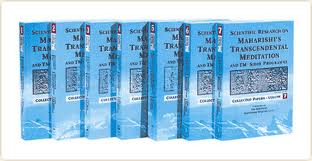
Over 600 scientific studies done at over 100 independent research institutions in over 160 peer reviewed journals validate the benefits of TM. Many of these studies are reprinted in 7 volumes of the Collected Papers available from Maharishi University Press. |
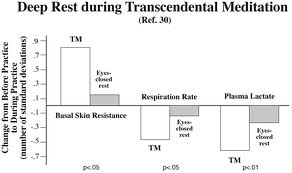
Physiological research has shown that Transcendental Meditation gives rise to a unique state of deep rest characterized by marked reductions in metabolic activity [3-13], increased orderliness and integration of brain functioning [14-27], increased cerebral blood flow [6, 28, 29], and features directly opposite to the physiological and biochemical effects of stress, including skin resistance changes [3, 8, 30, 31] and reductions in plasma cortisol [32-35], arterial blood lactate [3, 6, 7, 11, 30], and muscle tone [15, 36]. Several other neuroendocrine changes have also been observed during Transcendental Meditation [31, 37-44]. Taken together, these studies clearly distinguish the physiology of Transcendental Meditation from sleep or simple relaxation [13, 30] |
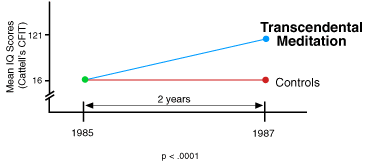
Students at Maharishi
International University in Fairfield, Iowa, who regularly
practiced Transcendental Meditation, increased significantly in
intelligence over a 2-year period, compared to control subjects
from another Iowa university. This finding corroborates the results
of two other studies showing increased IQ in Maharishi
International University students.
Reference I: Transcendental Meditation and improved performance on intelligence-related measures: A longitudinal study, Personality and Individual Differences 12: 1105-1116, 1991. Reference II: Longitudinal effects of the Transcendental Meditation and TM-Sidhi program on cognitive ability and cognitive style, Perceptual and Motor Skills 62: 731738, 1986. |
 |
|
Peer Reviewed Scientific Journals |
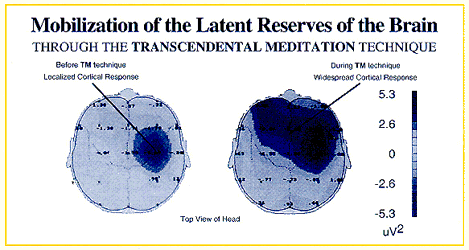
This study found
that during the Transcendental Meditation program some of the early
sensory components of the brain's response to somatosensory
stimulation (0–100 msec) are more widely distributed across the
cortex. This study, by Dr. Nicolai Nicolaevich Lyubimov, Director
of the Moscow Brain Research Institute's Laboratory of
Neurocybernetics, indicates that during the Transcendental
Meditation program there is an increase in the areas of the cortex
taking part in perception of specific information and an increase
in the functional relationship between the two hemispheres.
References: |
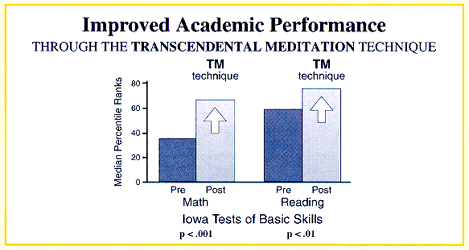
After one year of practice of the Transcendental Meditation program, elementary school students showed significant gains on the lowa Tests of Basic Skills, a nationally standardized test (ref. 1). A second study showed significant gains in high school students (grades 9–12) on the lowa Tests of Educational Development (ref. 2). A third study (ref. 3) found that the length of time students had been practicing the Transcendental Meditation program was significantly correlated with academic achievement, independent of student IQ scores.
References: |
National Institutes of Health
|